
Argentina’s World Cup Journey:
As the 2026 FIFA World Cup comes to a close, Argentina has once again captured the imagination of the football world. Four years after lifting the trophy in Qatar and exactly 40 years after Diego Maradona’s legendary triumph in Mexico, La Albiceleste embarked on another unforgettable journey—one filled with dramatic comebacks, emotional victories, and remarkable numerical powers.
Whether viewed as meaningful patterns, symbolism, or simply extraordinary coincidences, the connections make for a fascinating narrative.
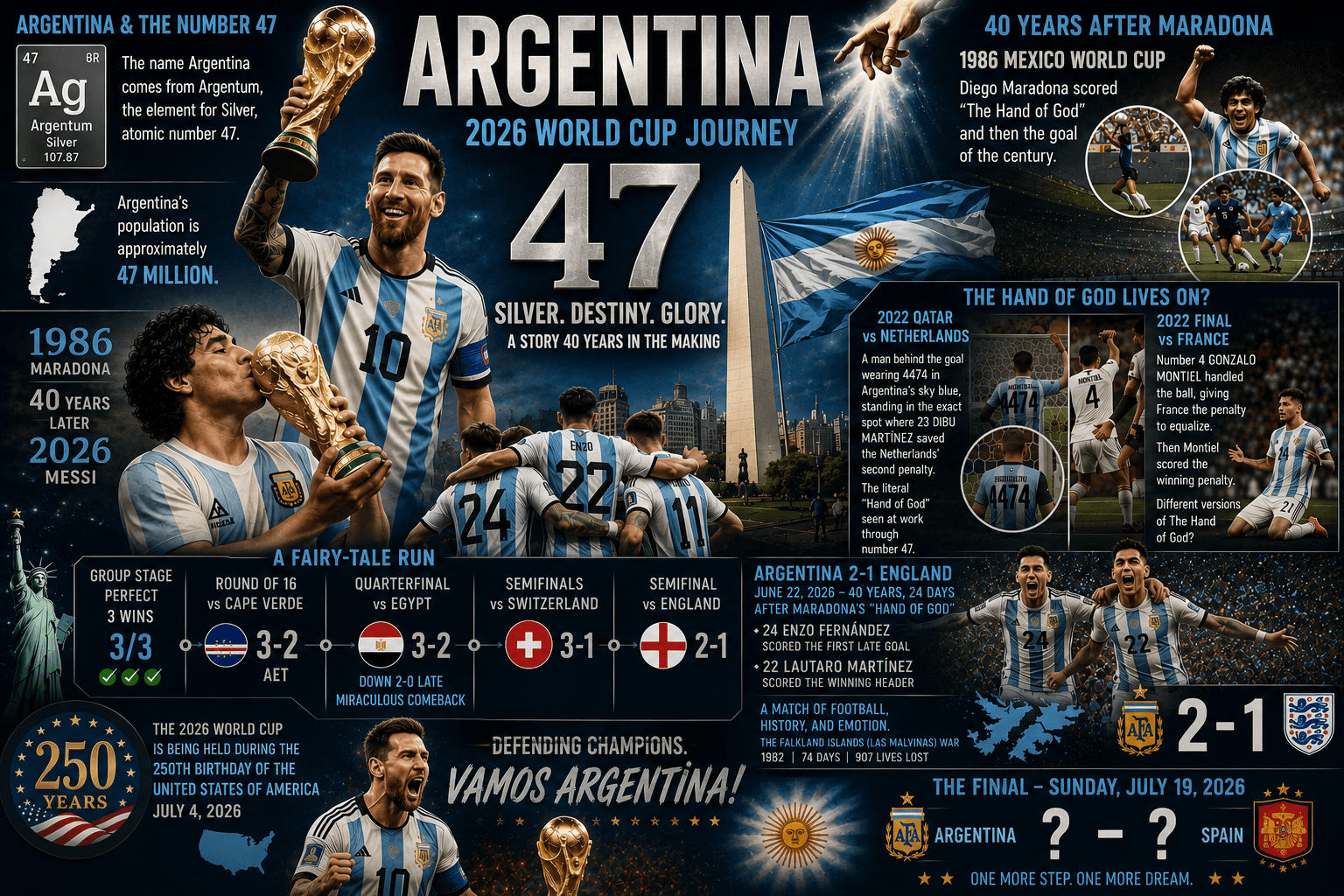
Argentina and the Number 47

Few nations carry a stronger natural association with the number 47 than Argentina.
The very name Argentina comes from the Latin word Argentum, meaning silver—the chemical element with the atomic number 47.
Today, Argentina’s population is estimated at approximately 47 million people, giving the nation another striking connection to the same number.
For many, these are simply interesting facts. For others, they represent another layer in Argentina’s miraculous football story.
Heartbreak Before Glory: Messi’s Long Road to Redemption
Argentina’s journey has not been one of constant glory. Before lifting the World Cup in Qatar and making another inspiring run in 2026, they endured some of the most painful defeats in modern football.
The heartbreak began in the 2014 FIFA World Cup Final, where Argentina fell to Germany after extra time. Then came two more crushing blows against Chile.
The 2015 Copa América Final, played on July 4, 2015, at the Estadio Nacional in Santiago, Chile, ended with Argentina losing in a penalty shootout. One year later, history repeated itself in the 2016 Copa América Centenario Final, played on June 26 at MetLife Stadium in East Rutherford, New Jersey. Once again, Chile prevailed on penalties, and once again Lionel Messi was left in tears.
Those moments were difficult to watch. Even though my family’s roots are in Chile, I couldn’t help but feel heartbroken for Messi. Seeing one of football’s greatest players come so close, only to fall short time after time, was emotional for fans around the world.
From Rejection to Redemption
After years of heartbreaking defeats, Lionel Messi faced some of the harshest criticism of his career—not from rival fans, but from many in his own country.
Argentina had lost the 2014 FIFA World Cup Final to Germany, followed by back-to-back Copa América Finals to Chile in 2015 and 2016, both in penalty shootouts. Each defeat deepened the frustration of a nation desperate to see its greatest player lift a trophy in the famous sky-blue and white jersey.
Questions filled the air. Was Messi somehow cursed with the national team? Would he ever win a major tournament for Argentina? Some critics even argued that Diego Maradona’s legacy would never be matched.
The pain reached its peak after the 2016 Copa América Centenario Final at MetLife Stadium in East Rutherford, New Jersey. Following another heartbreaking penalty shootout loss to Chile, a devastated Messi announced his retirement from international football on his birthday June 27, 2016, saying that perhaps the national team “wasn’t for him.”

His decision shocked the football world.
Almost immediately, Argentina erupted with support. Fans who had criticized him began pleading for him to return. Across the country, banners appeared, campaigns were launched, and one message echoed louder than any other: “Don’t go, Leo.”
Messi listened.
Just weeks later, he reversed his decision and returned to the national team. That decision changed the course of Argentine football history.
What followed became one of the greatest redemption stories the sport has ever witnessed. Argentina won the 2021 Copa América, ending a 28-year trophy drought. They followed it with the 2022 Finalissima, then captured the 2022 FIFA World Cup in one of the greatest finals ever played. Messi, once questioned and doubted by many, completed his career by lifting every major trophy available with Argentina and cementing his place among football’s greatest legends.
Sometimes the greatest victories are born from the deepest heartbreak. Looking back, those painful defeats did not define Messi or Argentina—they prepared them for one of the most remarkable stories of redemption in sports history.
10 years later, the story comes full circle.
The 2026 FIFA World Cup Final will be played at MetLife Stadium—the very same field where Argentina lost the 2016 Copa América Centenario Final in a heartbreaking penalty shootout against Chile.
Football has a remarkable way of creating poetic moments. Whether by coincidence or destiny, Argentina returns to the site of one of its deepest wounds (this time against Spain) with an opportunity to write a completely different ending.
After their inspiring journey through the 2026 World Cup, many supporters believe this team is destined to complete the story—not by erasing the pain of the past, but by transforming it into the greatest triumph of all.
Forty Years After Maradona
The 2026 World Cup arrived exactly 40 years after Diego Maradona led Argentina to the 1986 World Cup title in Mexico, one of the most memorable tournaments in football history.
That tournament produced two of the sport’s most famous goals within minutes of one another against England.
The first became known forever as “The Hand of God,” when on June 22, 1986 Maradona punched the ball into the net.

Just moments later, he scored what many still consider the greatest goal in World Cup history, dribbling past nearly the entire English team before finishing brilliantly.
Those two goals became symbols of football history—one controversial, one universally admired.
Interestingly, one year later, on June 24, 1987, Lionel Messi was born.
The “Hand of God” in Qatar?
The 2022 World Cup added another chapter that some supporters have connected to Argentina’s football folklore.
During the penalty shootout against the Netherlands, television footage showed a man standing directly behind the goal wearing an Argentina colored sky-blue uniform displaying the number 4474 in the back. Remarkably, he appeared positioned almost exactly behind the spot where the hand of goalkeeper Emiliano “Dibu” Martínez (No.23) saved the Netherlands’ second back-to-back penalty—one of the best games in the tournament that sent Argentina toward the semifinals.
Another Version of the “Hand of God”?
The World Cup Final against France produced yet another unforgettable moment involving a hand.
Late in the match, defender Gonzalo Montiel (No.4), caused a hand ball inside the penalty area, allowing France to equalize from the penalty spot.

The story came full circle during the penalty shootout.
Montiel stepped forward to take Argentina’s final penalty and calmly converted it, securing Argentina’s third World Cup title.
One hand appeared to place the championship in jeopardy.
Then a kick from the very same player secured football immortality.
Some have wondered whether these moments represent modern echoes of Maradona’s famous “Hand of God”—not in the literal sense, but as another chapter in Argentina’s long history of unforgettable moments involving hands, destiny, and World Cup drama.
A Fairy-Tale Run in 2026
As defending champions, Argentina entered the 2026 World Cup carrying enormous expectations.
They answered those expectations immediately.
Argentina swept through the group stage with three convincing victories, finishing first with maximum points while playing some of the tournament’s most entertaining football.
But once the knockout rounds began, every match became a test of resilience.


Cape Verde’s Historic Challenge
The Round of 16 nearly produced one of the greatest upsets in World Cup history.
An inspired Cape Verde side pushed the defending champions to the limit before Argentina finally escaped with a dramatic 3–2 victory after extra time.

A Miraculous Comeback Against Egypt
The quarterfinal became even more remarkable.
Trailing 2–0 late against Egypt, Argentina appeared headed for elimination.
Instead, the champions produced an astonishing comeback, scoring three unanswered goals to win 3–2, one of the greatest rallies ever witnessed on the World Cup stage.

Switzerland Pushes Argentina Again
Switzerland provided yet another stern challenge in the semifinals’ path.
After a tense opening hour, Argentina eventually broke through, winning 3–1 to continue their remarkable journey.

England, Forty Years Later
The semifinal carried significance beyond football.
Argentina defeated England in another unforgettable contest exactly 40 years and 24 days after Maradona’s famous June 22, 1986, “Hand of God” performance.
The match also revived one of football’s most emotionally charged rivalries, shaped not only by sporting history but also by the 1982 Falklands (Las Malvinas) War, a 74-day conflict between Argentina and the United Kingdom that resulted in 907 total deaths.
The emotions were intense from kickoff to the final whistle.
Late in the match, Enzo Fernández (No. 24) scored Argentina’s breakthrough goal.
Moments later, Lautaro Martínez (No. 22) headed home the winner, sending Argentina into another World Cup Final.
Forty years after Maradona stunned England in Mexico, Argentina had once again written a memorable chapter against the same opponent.

Spain: Messi and Yamal’s Incredible Full-Circle Story
The 2026 FIFA World Cup final between Argentina and Spain feels like more than just a battle for football’s biggest prize—it feels like a symbolic passing of the torch. On one side stands Lionel Messi, the legendary World Cup winner whose career has inspired an entire generation. On the other is Lamine Yamal, the teenage sensation who has quickly become one of the brightest stars in world football. Their meeting on the sport’s grandest stage is a matchup that few could have imagined, yet it somehow feels destined.

What makes this final even more extraordinary is the remarkable story connecting the two long before either could have predicted this moment. In 2007, a young Messi took part in a Barcelona and UNICEF charity photoshoot, where he posed with and gently bathed a six-month-old baby—who, by pure coincidence, was Lamine Yamal. At the time, it was simply a promotional event. Nearly two decades later, that baby has grown into Spain’s biggest star and will line up across from Messi in a World Cup final, one of the most astonishing full-circle moments in sports history.
The image has since become one of football’s most iconic photographs, capturing a moment that no one could have understood at the time. It serves as a reminder that football is more than trophies and statistics—it is a game that connects generations in unexpected ways. Whether Argentina or Spain lifts the trophy, the Messi-Yamal story has already secured its place among the sport’s greatest coincidences, linking the game’s past, present, and future in a single unforgettable picture.
Record-Breaking 2026 FIFA World Cup during USA’s 250th Birthday
The 2026 World Cup itself unfolded during a historic moment for one of its host nations.
The United States celebrated the 250th anniversary of the Declaration of Independence on July 4, 2026, giving the tournament an additional layer of historical significance as millions of fans gathered across North America to celebrate football on one of the nation’s most important anniversaries.
The 2026 World Cup has rewritten the history books, delivering the biggest and most successful tournament the sport has ever seen. Hosted across the United States, Canada, and Mexico, this edition became the first World Cup to feature 48 national teams and an expanded 104-match format, allowing more countries than ever before to compete on football’s biggest stage. The tournament’s larger format brought unforgettable moments, dramatic upsets, and a truly global celebration of the game.

The records extended far beyond the expanded field. The tournament set new all-time attendance marks, drawing approximately 6.7 million fans across its matches, surpassing every previous World Cup. It also became the highest-scoring World Cup in history, breaking the previous goals record before the group stage had even concluded. Television audiences reached historic levels as well, with record-breaking viewership in multiple countries, reflecting the tournament’s worldwide appeal and growing popularity.
On the field, football’s biggest stars continued to make history. Lionel Messi added to his legendary World Cup legacy by breaking multiple tournament records during Argentina’s run to the final, while the emergence of young stars like Lamine Yamal highlighted the arrival of a new generation ready to carry the sport into the future. As the tournament concludes with the highly anticipated final between Argentina and Spain, the 2026 FIFA World Cup will be remembered not only for crowning a champion but for setting a new benchmark in attendance, entertainment, and global impact that future tournaments will strive to match.
History, and Symbolism
Argentina’s 2026 campaign became more than a football tournament.
It connected generations—from Maradona’s unforgettable exploits in 1986 to Lionel Messi’s era and beyond.

Whether one sees destiny, symbolism, or chance, Argentina’s remarkable run once again demonstrated why football often feels larger than the game itself—a sport where history echoes across generations, legends inspire new heroes, and every World Cup writes another unforgettable chapter..
The Grand Finale: Argentina vs Spain
Football has always been more than a game. It is a story of hope, heartbreak, resilience, and the courage to dream again.
Every nation that steps onto the World Cup stage knows one truth: only one team will lift the trophy, but every team has the opportunity to inspire the world.
For Argentina, this journey ends with silver. Some may see second place. I see another chapter in one of football’s greatest legacies. Fittingly, Argentina’s name comes from the Latin word argentum, meaning “silver”—a reminder that even history has a beautiful way of writing its own stories.
A nation of 47 million Argentines carried the hopes of millions more around the globe. Together, they gave us moments of joy, pride, passion, and belief. Their recent World Cup story is extraordinary: finalists in Brazil 2014, world champions in Qatar 2022, and finalists once again in the 2026 World Cup across Canada, Mexico, and the United States. Few generations ever witness a run like that.
This loss hurts. As one of millions of Lionel Messi fans, I wished with all my heart to see him lift football’s greatest prize one more time. But legends are not defined by their final match. They are defined by the lives they change, the dreams they ignite, and the generations they inspire. Messi has already given the world more magic than words can ever describe, and this tournament only added another unforgettable chapter to his remarkable legacy.
To every player who wore the Albiceleste with pride, to every family that celebrated every goal, to every child who believed because of this team, and to every fan whose heart beat with Argentina from every corner of the world—hold your heads high. Silver is not failure. It is proof that you stood among the very best on Earth.
Congratulations to Spain on a magnificent and well-earned victory. Champions are forged through excellence, and your triumph deserves to be celebrated.
The beauty of football is that every ending is also a beginning. New stars will rise. New dreams will be born. New World Cups will be played. And somewhere, another generation will dare to believe because Argentina showed them that greatness is not only found in lifting a trophy—it is found in never stopping the pursuit of it.
Until we meet again on football’s biggest stage. The story isn’t over. The next chapter is already waiting.

