
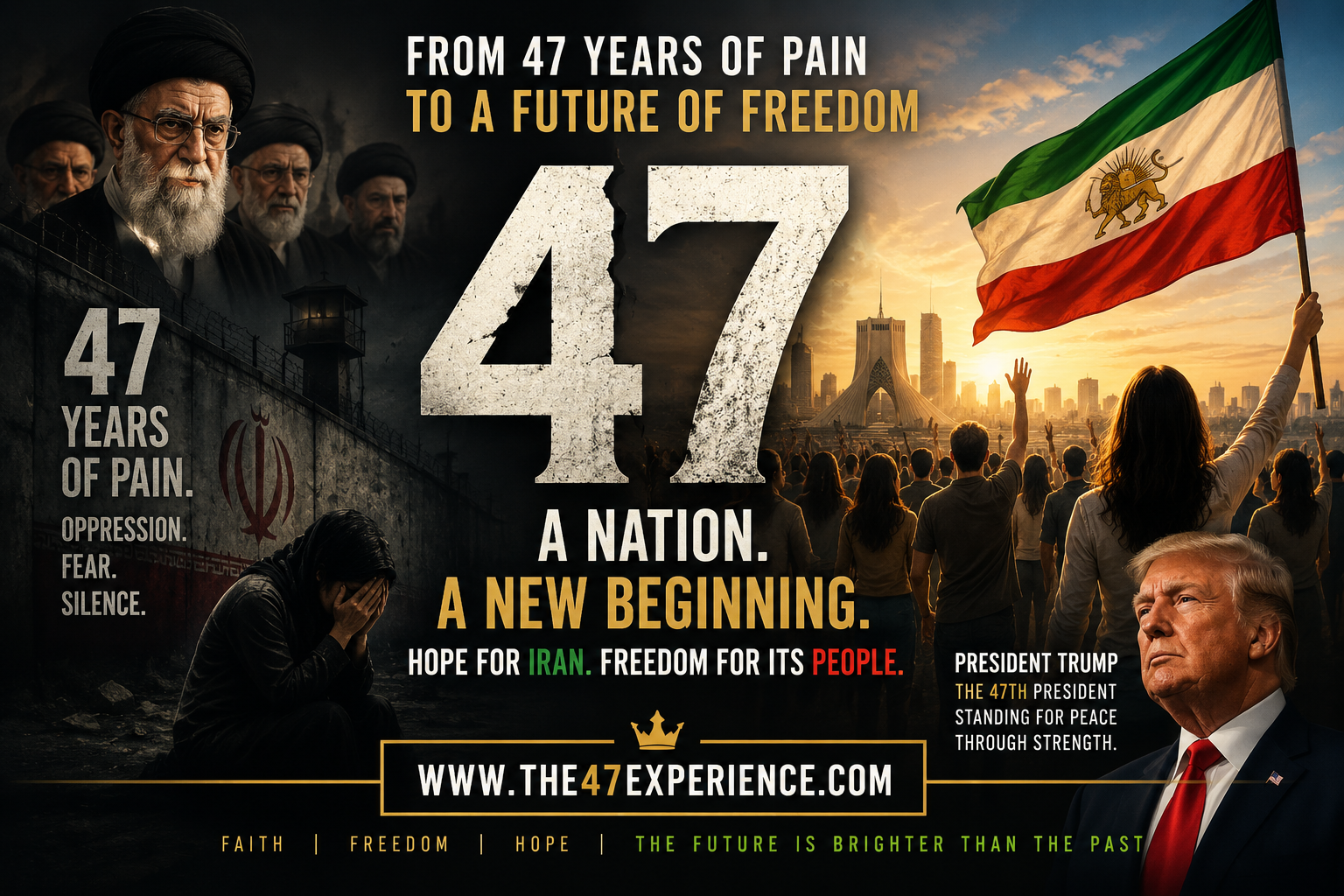
Iran’s 47 Years of Pain: A Nation’s Hope for Freedom
History Shows That Change Is Possible
History often reminds us that no political system lasts forever. Every generation reaches a defining moment when change becomes possible. Many Iranians have long dreamed of a future marked by greater freedom, opportunity, and peace.
For 47 years, the Islamic Republic of Iran has governed one of the world’s oldest civilizations. Throughout those decades, millions of Iranians have experienced political repression, economic hardship, international isolation, and limitations on many personal freedoms. Yet despite these challenges, the Iranian people have continued to demonstrate remarkable resilience, preserving their rich culture, history, and hope for a brighter future.
47th President Trump and U.S. Policy
As Iran marks 47 years under the Islamic Republic, America’s 47th President has become a central figure in confronting the regime.
Donald J. Trump, the 47th President of the United States, has taken a firm stance toward the Iranian government. His administration has emphasized economic pressure, military deterrence, and efforts to limit Iran’s nuclear ambitions. Supporters argue that these policies have weakened the regime’s ability to project power and have increased pressure for change. Critics have raised concerns about the risks of escalating tensions and the humanitarian effects of sanctions. Regardless of one’s political perspective, there is little doubt that U.S. policy toward Iran has remained a major focus of international affairs.
Can Peace Begin with Iran’s Leadership?
If Iran truly seeks lasting peace, many believe that change must begin with its leadership. Political reform, accountability, and a commitment to the rights and freedoms of its citizens are essential steps toward a more peaceful future.
Critics of the Islamic Republic argue that the government has intertwined religion and state so closely that Islam, as interpreted by the ruling establishment, functions not only as a faith but also as the basis of political authority. They contend that this has allowed religious doctrine to be used to justify state power and suppress dissent.
Understanding the Debate Over Surah Muhammad (47:4)
One passage that is frequently discussed is Surah Muhammad (47:4), which, in part, states:
“When you meet those who disbelieve in battle, strike their necks until you have subdued them. Then bind them firmly. Thereafter, either release them graciously or for ransom until the war lays down its burdens.”
This verse has become controversial because it is interpreted in different ways. Many Muslim scholars teach that it refers specifically to warfare in the historical context of the early Muslim community and is not a command for violence against civilians or non-Muslims generally. Others, however, have cited the verse to justify acts of extremism. Those competing interpretations have contributed to fear and mistrust, particularly in the West.
The Lasting Impact of September 11
For many Americans, the memory of September 11, 2001, remains vivid. Those who lived through that day remember the shock, grief, and lasting impact it had on the nation. While younger generations know the events primarily through history, millions of Americans still carry the memories of that tragic day.
Religious Freedom and America’s Constitutional Values
Concerns about religious freedom and the preservation of constitutional values continue to shape public debate in the United States. Some Americans are concerned about efforts by individuals or groups to influence public policy or local government according to their religious beliefs. At the same time, the Constitution protects every person’s right to practice their faith—or no faith at all—without government coercion.
Violence committed in the name of religion, whether by extremists claiming to act for Islam, Christianity, Judaism, or any other faith, deserves clear and unequivocal condemnation. Many people believe that religious leaders and communities strengthen public trust when they consistently denounce terrorism and reject the misuse of sacred texts to justify violence.
The United States was founded on the principles of liberty, religious freedom, and the rule of law. Those freedoms belong equally to every American, and they remain worth protecting for future generations.
The Symbolism of 47
The number 47 has become symbolic to many people. Some see it as simply a coincidence—the 47th year of the Islamic Republic and the 47th President of the United States standing at a pivotal moment in history. Others view it through a spiritual lens, believing that God often uses unexpected moments and unlikely circumstances to redirect the course of nations.
Whether one sees symbolism or coincidence, history reminds us that great changes often begin when hope refuses to die.
A Message to the People of Iran
To the courageous people of Iran:
Your identity is far greater than any government. You are the heirs of Cyrus the Great, of poets like Hafez and Rumi, of scientists, artists, and builders whose contributions have enriched the world for thousands of years. Your future should be defined not by fear, but by freedom, dignity, and opportunity.
Never lose hope. Darkness never has the final word. Every nation that has endured oppression has also witnessed the possibility of renewal. Continue believing that a better tomorrow is possible—for your children, your families, and generations yet to come.
For those who believe in God, remember that His purposes often unfold in ways we cannot immediately understand. Some may see the number 47 as a reminder that history is moving according to a greater plan. Whether it is coincidence or providence is ultimately a matter of personal faith, but hope itself is never misplaced.
May the people of Iran find peace instead of conflict, liberty instead of oppression, and unity instead of fear. May the next chapter of Iran’s story be written not with violence, but with courage, wisdom, and reconciliation.
Hope Is Stronger Than Fear
The future belongs to those who refuse to surrender hope.
